
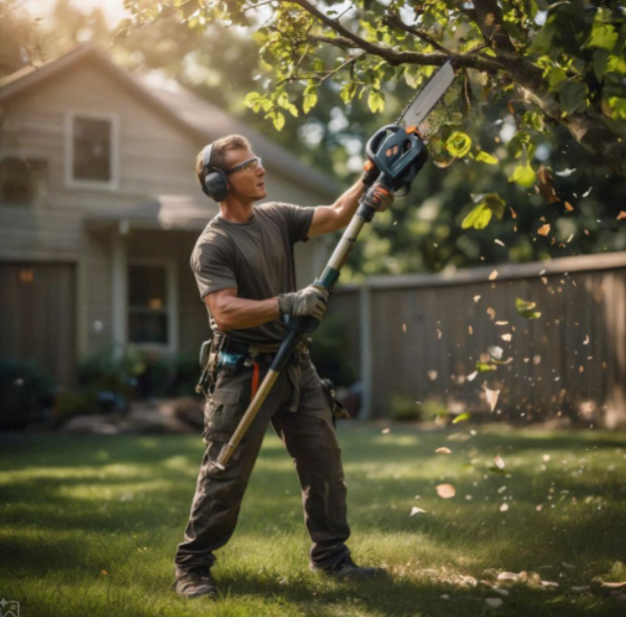
I recently set out to buy an electric pole saw and did what any careful shopper does: I dug into the reviews. What struck me was that the same complaints kept surfacing, regardless of brand or price point. Rather than let those frustrations stop you in your tracks, I decided to put together a practical guide to the most common electric pole saw problems and, more importantly, how to solve them.
1. It Won’t Cut- Brand New Out of the Box
Pole Saw problem: You unbox your new pole saw, fire it up, and it barely scratches the wood. Or it seems to burn the wood more than cut it.
The solution: Check whether your chain is on backwards (this is like trying to cut with an upside-down knife). This sounds almost too simple, but it’s a surprisingly common mistake — even among experienced users. I made this exact error early in my chainsaw days.
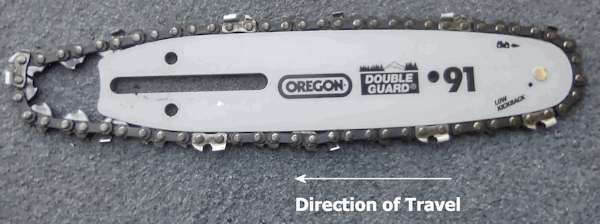
Here’s what to know: Chainsaw chains have cutting links (alternating on the left and right side of the chain) separated by connecting links. Cutting links have a small hump (called a depth gauge or raker) positioned in front of each cutting edge. The raker’s job is to limit how aggressively the blade bites into the wood. If the chain is installed in reverse, those cutting edges are facing the wrong direction, and the saw won’t cut at all.
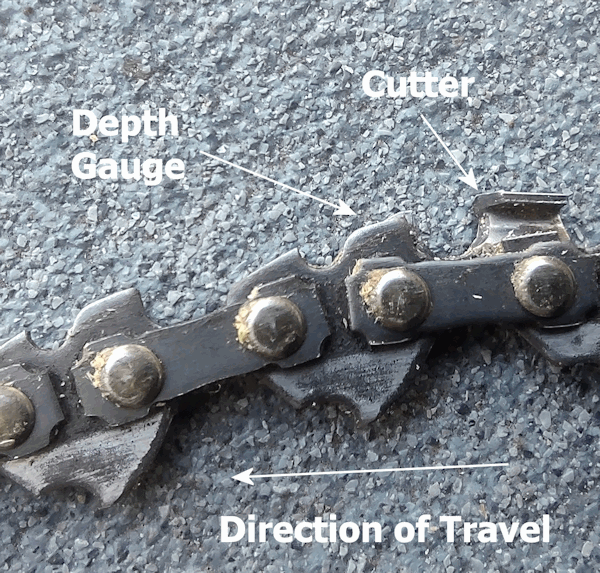
The rule to remember: The chain travels with the cutting edge facing toward the saw along the bottom of the bar. Flip it the wrong way, and all you’ll get is frustration.
2. The Chain Keeps Jumping Off the Bar
Pole Saw problem: This is the most common complaint across every brand, and it has several possible causes.
a. The Chain Isn’t Tight Enough
Getting proper chain tension is trickier than the instructions make it sound. Most manuals say to leave enough slack so you can pull the chain down slightly from the bar — but that guidance leaves a lot of room for interpretation. How hard should you pull? Turns out, harder than you think.
There’s also a mechanical catch: when you do the final tightening of the bar, that motion often loosens the chain you just set. It’s a maddening little gotcha.
The fix: Tighten the chain pretty firmly before you lock the bar down. Once the bar is fully tightened, check the slack again — pulling the chain with real force. You want approximately 1/8 inch of play, no more. Next, grab the chain and try to slide it around the bar. It should be relatively easy to move; if you can’t slide it, it’s too tight. When you run the saw, listen carefully: a scraping or grinding noise means it’s too tight. Normal noise, smooth operation — you’re good to go.
b. The Bar Is Bent
Pole saws are front-heavy. If you set the saw down carelessly (especially on its side), the bar can strike the ground at an angle and bend. Even a slight bend can be enough to derail the chain repeatedly.
The fix: Inspect the bar closely if you’re having chain derailment issues. When it is off the machine, check it on a flat, smooth surface. And from now on, always set the saw down with care, keeping the bar from contacting hard surfaces. This is less of a problem on a regular chainsaw because the bar stays vertical, but on a polesaw, it is too easy to lay it down on its side bar first.
Pro Tip: Remove the bar and chain when storing your pole saw, so the bar doesn’t get bent.
c. The Bar Track Is Clogged
Sawdust, sap, and debris can pack into the groove that runs along the edge of the bar — the track that keeps the chain seated. When that track gets clogged, the chain has nowhere to run and pops off.
The fix: Most electric pole saws come with a combination tool that doubles as a screwdriver and a bar-track cleaning tool. The flat end is shaped specifically to fit into the groove. Use it regularly. That said, sometimes the buildup is stubborn enough that even this tool can’t reach it; in that case, a sturdy knife or a narrow pick does the job. Make track cleaning a routine part of your maintenance.
d. Debris Between the Sprocket and the Bar
Material can quickly accumulate in the gap between the drive sprocket and the bar. Even a small amount of packed debris can push the chain sideways just enough to redirect it out of the track.
Think of it like a multi-speed bicycle: it doesn’t take much lateral force to shift gears. The same physics apply to a chainsaw chain — a small sideways nudge is all it takes to send it off course.
The fix: Regularly check the sprocket area while cutting. Pull out any sticks, wood shreds, or debris promptly.
3. The Pole Feels Flimsy
Pole Saw problem: Every brand gets this complaint. At full extension, the pole flexes and wobbles in a way that feels (and is) difficult to control and easy to bend.
The reality: This one doesn’t have a clean fix, because it’s fundamentally a design trade-off. Pole saws are engineered to be lightweight so you can hold them overhead for extended periods. But lightweight and rigid/strong are competing priorities, and at 8 or 9 feet of extension, physics isn’t on your side. The leverage forces at that length are tremendous.
The workaround: Use the pole at full extension only when absolutely necessary. Whenever a branch is reachable at a shorter extension, keep the pole retracted. When you do need the full reach, work slowly and carefully. Remember, if the extended leverage makes it impossible to hold the weight, and the heavy end comes crashing down, striking the ground, it can bend the bar or even break the pole.
4. There’s a Weird Plug on the End — Is It Broken?
PoleSaw problem: You pull your pole saw out of the box and notice what looks like an odd plug instead of power prongs. Some buyers assume it needs a strange adapter or something.
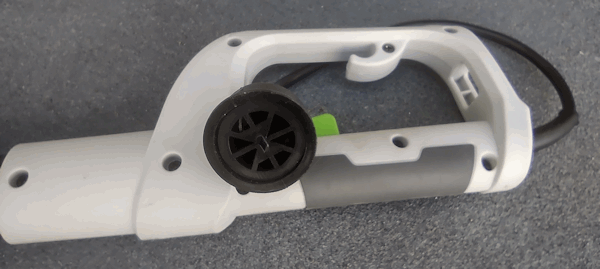
The solution: It’s not broken — it’s a shipping protector. Manufacturers put a plastic cover over the prongs to prevent damage in transit. Grab the tab in the center with a pair of pliers and pull it straight off. It should come free without much effort.
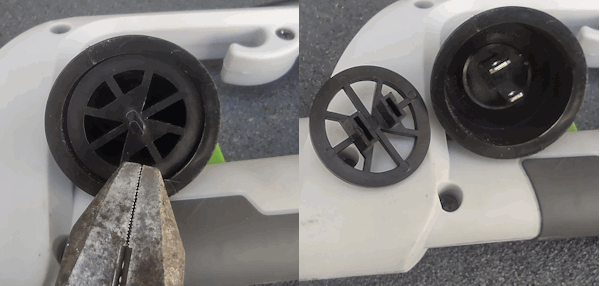
Why doesn’t anyone know about this? Because most instruction manuals never mention it. It’s one of those things that seems obvious in hindsight but catches almost everyone off guard the first time.
Bonus Tips
- Never run your saw without bar oil.
- Don’t use dirty motor oil, bar oil has sticky additives.
- Check your bar oil level regularly.
- Both rails on the bottom track should be parallel; worn rails cause problems.
- If the bottom of your bar gets worn, you can flip it upside down.
- Chains do need sharpening, best to get it professionally done.
- Bars and chains are considered “consumables” after several sharpenings.
Final Thoughts
Electric pole saws are genuinely useful tools, and most of the problems people run into are fixable once you know what to look for. The chain direction issue and the tension problem alone account for a huge percentage of bad first experiences. Armed with the fixes above, you should be able to get your saw running the way it’s supposed to — and keep it that way.
Have a pole saw problem that isn’t covered here? Drop it in the comments, and I’ll do my best to help.
You might also like:
